Cave rescue
Until the end of the 1950s, the few accidents that occurred were dealt with independently by local caving groups and the fire brigade.
In 1965, Italian caving was in full expansion. This encouraging interest was overshadowed by two fatal accidents, one of them in a complex cave at a depth of approximately 300 metres.
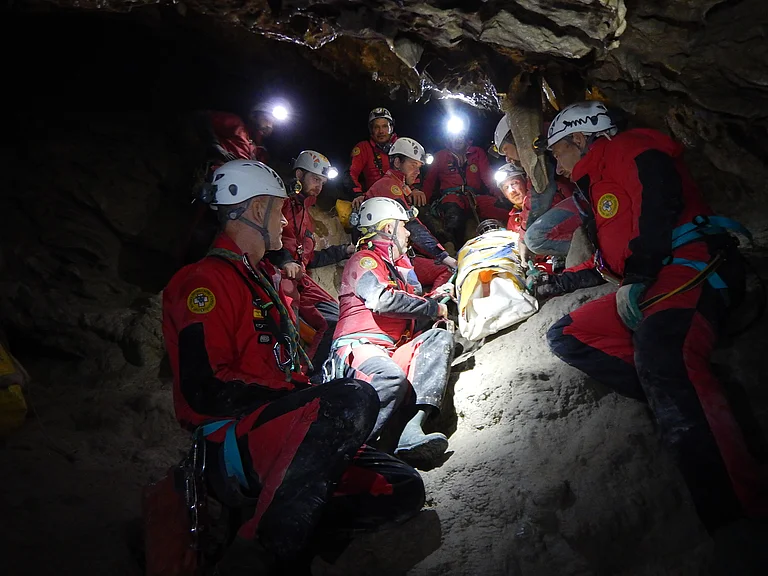
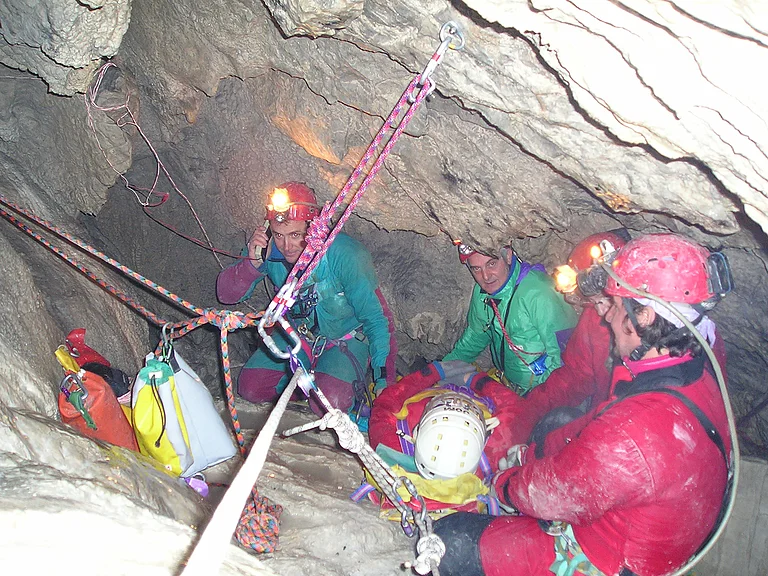
More than 30 speleologists from across northern Italy were involved in recovering the body. It was found that this type of operation took almost 6 days.
This operation provided an opportunity to strengthen the relationships between the various groups and to realise that certain problems can only be solved through the cooperation of all.
The following year, in 1966, the inaugural meeting of the ‘Corpo di Soccorso Speleologico’ was held in Turin on 5 and 6 March, attended by over 100 speleologists.
In the same year, thanks to the efforts of Bruno Toniolo, director of the ‘Corpo di Soccorso Alpino’, the newly founded cave rescue service was incorporated into the national mountain rescue service of the Club Alpino Italiano (CAI).
There are currently 650 technicians/volunteers in Italy, divided into 14 cave rescue zones. There are also several committees that focus their work on specific areas: technology, medicine, underwater rescue and waterfalls.
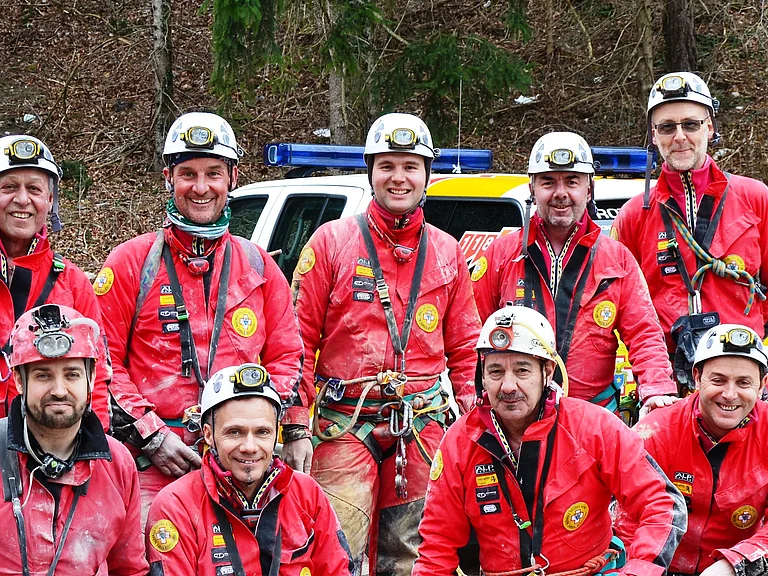
The cave rescue unit of the South Tyrolean Mountain and Cave Rescue Service (CNSAS) is part of the 6th Zone: Veneto – Trentino – South Tyrol.
It works together with the teams from Veneto and Trentino, organises joint exercises and, in emergencies, is also called upon for operations in neighbouring zones and for large-scale operations throughout Italy.